Le Musée d’arts de Nantes est climatisé et ouvert à toutes et tous gratuitement jusqu’à la fin de la vigilance canicule rouge aux horaires habituels (fermé le mardi).
This text was written during writing workshops led by author Mathieu Simonet at the Nantes detention center in November 2025. A group of inmates was invited to select works from the permanent collection of the Nantes Museum of Art and use them as inspiration to write 20 labels that are displayed throughout the galleries. This exhibition, on the theme of clouds in painting, is on view until March 29, 2026, the date of the next International Cloud Day.
This project was led by the cultural department of the Ligue de l’Enseignement des Pays de la Loire and the visitor services department of the Nantes Museum of Art, as part of the exhibition Sous la pluie, Peindre, vivre et rêver (Under the Rain, Painting, Living and Dreaming) ( November 7, 2025 – March1, 2026).
This project is part of the cultural program of the SPIP (Public Service for the Integration of Former Offenders) of Loire-Atlantique, in conjunction with the Nantes Penitentiary Center.
This project is supported by the Ministry of Culture – Regional Directorate for Cultural Affairs of the Pays de la Loire region and by the Ministry of Justice – Interregional Directorate of Prison Services of Brittany, Normandy, and Pays de la Loire/SPIP Loire-Atlantique, as part of the regional Culture/Justice agreement.
Interdepartmental Culture-Justice Program
Orazio Gentileschi, Diana the Huntress,17th century
Room 2: Orazio GENTILESCHI
Pisa, 1563 – London, 1639
Diana the Huntress
Before 1631 Oil on canvas Commissioned in 1630 by Roger du Plessis de Liancourt, Duke of La Roche-Guyon
This painting depicts Diana, goddess of hunting and wilderness. A twilight deity, she is associated with the moon, just as her twin brother Apollo is associated with the sun. She is recognizable here thanks to her traditional attributes: the crescent moon above her head, the horn, the bow and quiver, and her greyhound, which she holds on a leash. The very low horizon line accentuates her grandeur. In motion, with her back to us but slightly turned toward the viewer, she blows her horn with full cheeks. A wide green tunic flutters elegantly around her and energizes the composition.
In this seascape, Simon de Vlieger depicts a shipwreck scene: fishing boats are caught in a storm as they attempt to return to shore. Under a sky filled with large dark clouds, the boats are battered by the turbulent waves. An allegorical evocation, the storm also symbolizes the trials and tribulations that arise in life.
A master at depicting naval battles, de Vlieger also stands out for his paintings of calm seas dotted with ships sailing amid the waves. The rough surface of the water is conducive to the play of silvery gray light with great finesse. A student of the Flemish painter Adam Willaerts, the artist was influenced by his storms, while also drawing inspiration from the evolution of Dutch landscape art inthe 17th century .
Fournier Collection, purchased in 1814 ,Inv. 561
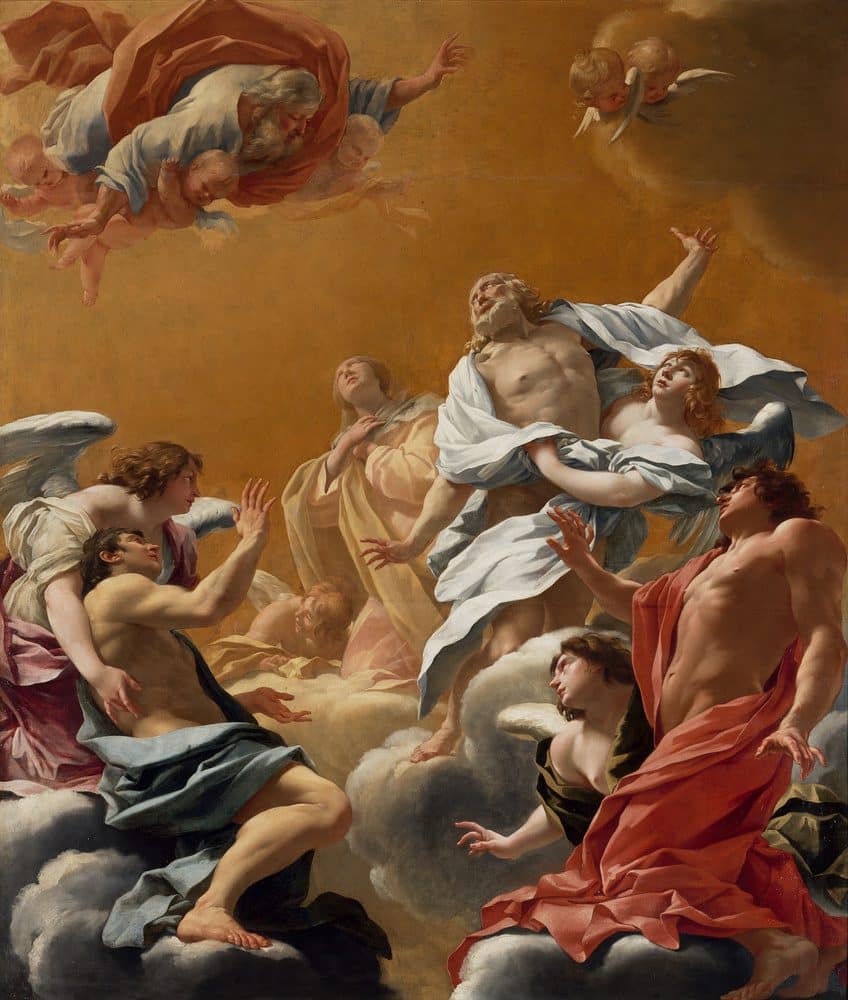
Simon Vouet, Saint Eustache and his family carried to heaven, known as The Apotheosis of Saint Eustache and his family, circa 1634–1637.
Room 6: Simon VOUET
Paris, 1590 – Paris, 1649
The Apotheosis of Saint Eustace and His Family
Around 1635 Oil on canvas
The painting once adorned the upper part of the high altar of the Church of Saint-Eustache in Paris. The lower part, depicting the martyrdom of the saint, is still preserved there.
According to Jacques de Voragine's Golden Legend, Saint Eustace, Trajan's general who converted to Christianity, was condemned to be burned alive with his entire family. The choice to depict martyrdom and apotheosis reflects the climate of the Counter-Reformation, which sought to exalt the spirit of sacrifice and dramatize and heroize the expression of faith. The highly dynamic composition (interplay of gazes, gestures, fluttering drapery) draws the eye into a celestial flight in the manner of the great Italian Baroque compositions.
After a long stay in Italy, Simon Vouet was recalled to France in 1627 by Louis XIII. The artist brought back a style that was previously unknown in France and profoundly renewed painting.
Sending of the state, 1809 . Inv. D.809.1.1.P
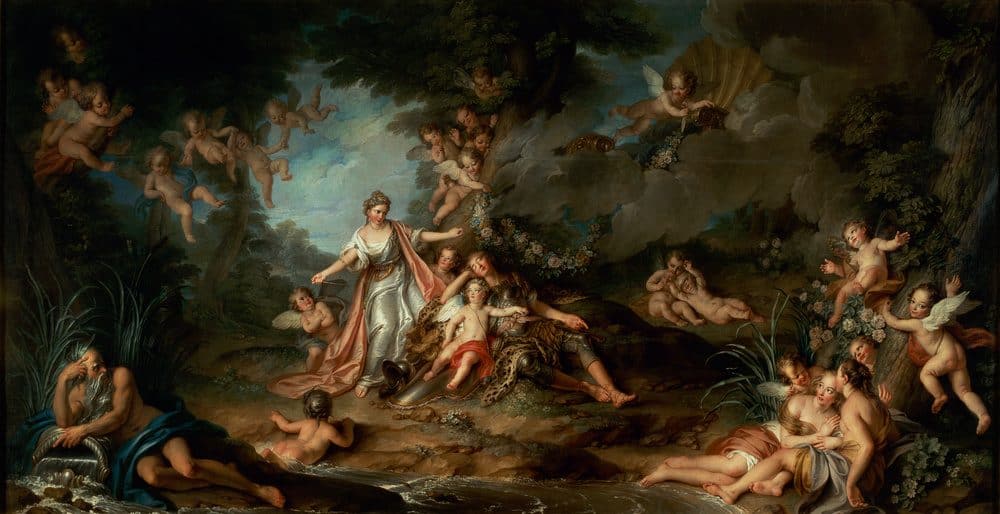
Charles Coypel, The Sleep of Renaud, 1741.
Room 7: Charles COYPEL
Paris, 1694 – Paris, 1752
Renaud's sleep
Circa 1741 Oil on canvas
In the center of the painting, the sorceress Armide is about to stab Renaud, whom she has plunged into a deep sleep. But upon discovering the knight's features, she falls in love with him. This scene depicts the precise moment when Armide's feelings shift from vengeance to love. It is inspired by the poem Jerusalem Delivered, written by Le Tasse inthe 16th century. In 1696, this love story set against the backdrop of the medieval crusades became a lyric tragedy by Philippe Quinault, set to music by Jean-Baptiste Lully, the masters of opera under Louis XIV. The work's success continued into the first half ofthe 18th century, and Coypel chose several episodes from it for a royal commission of tapestries. This very large painting served as a model for one of them. Coypel, who was both a painter and a playwright, forged strong links between the two artistic genres here.
Louvre Museum Collection, 1982 Inv. D.872.1.2.P
Giovanni Paolo PANNINI, Prediction of a Sibyl,18th century
Room 8: Giovanni Paolo PANNINI
Plaisance, 1691–Rome, 1765
Preaching of a Sibyl
18e siècle Huile sur toile
In a setting of ruins, the Sibyl of Tibur (now Tivoli), prophetess and priestess of Apollo, offers divination to soldiers. Pannini makes numerous references to Antiquity: a Medici vase, a small round temple in the background reminiscent of the Sibyl's temple in Tivoli, and a gigantic colonnade reminiscent of the Roman Forum. Beyond mere picturesque pleasure, the contrast between the grandeur of the ruins and the size of the humans offers a reflection on the inexorable power of time, which overcomes even the most grandiose undertakings, such as the Roman Empire.
Pannini is famous for his views of18th-century Rome and perhaps even more so for his architectural caprices, which blend real and imaginary ruins.
Purchased in 1841 . Inv. 115
Jean-François SABLET, View of the Roman countryside from the Appian Way, also known as "View of Tivoli, " 1803-1804?
Room 8: Jean-François SABLET
Morges, 1735 – Nantes, 1819
View of the Roman countryside from the Appian Wayalso known as "View of Tivoli"
1803–1804? Oil on canvas
This large landscape, painted several years after Jean-François Sablet's stay in Rome, offers a faithful depiction of the Via Appia below Ariccia. While the painter refrains from staging the idealized classical landscape, he does not hesitate to populate this beautiful late afternoon with picturesque characters, such as shepherds in traditional costumes with their sheep.
Son of Jacob Sablet, painter and art dealer, Jean-François Sablet was also a student of painter Joseph-Marie Vien, a pioneer of Neoclassicism. Trained mainly in Paris and during a brief stay in Rome after the Revolution, the artist settled permanently in Nantes in 1805. He is best known for his portraits of the local bourgeoisie and his artist and collector friends.
Donation by Mme de La Vauguyon (sister of the artist), 1841 . Inv. 709
Félix THOMAS, Banks of the Tiber, circa 1864
Room 10: Félix THOMAS
Nantes, 1815 – Nantes, 1875
Banks of the Tiber
circa 1864 Oil on canvas
This bucolic landscape probably depicts the upper Tiber Valley in central Italy. At the foot of the mountains lie fields used for grazing. In the foreground, a fisherman is preparing to cast his net into the river.
Félix Thomas was an architect, painter, and engraver. He won the Grand Prix de Rome in architecture in 1845, which allowed him to stay in Italy and travel to Constantinople, Athens, and Smyrna. From 1855 onwards, he exhibited landscapes at the Salon with some success.
Sent by the State Salon of 1864 . Inv. 1194
Edouard DEBAT-PONSAN, Corner of Vineyards, Languedoc, 1886
Room 14: Edouard DEBAT-PONSAN
Toulouse, 1847 – Washington, D.C., 1913
Vineyard corner, Languedoc
1886 Oil on canvas
Édouard Debat-Ponsan drew inspiration from his stays in his native Languedoc region for many of his depictions of life in the fields. The sloping path, the oblique line of the horizon, the cool tones, and the positioning of the figures in the space give the scene a real sense of scale. The attention paid to the veracity of every detail places the work firmly in the naturalist tradition, following in the footsteps of Courbet's Realism.
Trained in Alexandre Cabanel's studio, Debat-Ponsan exhibited at the Salon des Artistes Français from 1873 onwards, winning awards and honors. In 1898, he took the side of Captain Dreyfus, who had been unjustly accused of treason. This political stance led to a complete break with his family and clientele. He then took refuge in Touraine, continuing to paint portraits and landscapes, far removed from the new trends in painting.
Deposit from the National Center for Visual Arts, 1886 Inv. 919
Hugo-Frédérick SALMSON, The Little Gleaner, 1884
Room 14: Hugo-Frédérick SALMSON
Stockholm, 1843 – Lund, 1894
The Little Gleaner
1884 Oil on canvas
Sitting in the middle of a field with a bunch of wheat ears beside her, the little gleaner appears tired, her gaze distant. The girl's slumped posture, shoulders lowered and legs slightly crossed, reinforces this feeling of exhaustion. The particularly high horizon line allows the artist to play on the immensity of the harvested field, thus recalling the difficulty of her task. The realism of the portrait—the worn work clothes, the dirty boots—and the theme place this work within the naturalist trend that developed in themid-19th century.
After studying at the Stockholm School of Fine Arts, Hugo-Frédérick Salmson moved to Paris, where he enjoyed a successful career. From 1877 onwards, he focused on depicting rural life. In 1879, the French government purchased one of his paintings for the Musée du Luxembourg, which at the time was largely closed to foreign artists.
Purchased from the artist Salon, 1886 Inv. 1168
ANONYMOUS, Portrait of Théophile and Félicité Fernig,19th century
Room 15: ANONYMOUS
Portrait of Théophile and Félicité Fernig
19th century Oil on canvas
Born in 1770 and 1775 near Valenciennes, Félicité and Théophile Fernig were every bit the romantic heroines that the19th century loved to glorify. Like two Amazons, according to Lamartine, the young Fernig sisters joined the National Guard in 1792. Dressed in men's clothing and defying their father's authority, they opposed the Austrian soldiers who were threatening the new French society. The post-revolutionary narrative, undoubtedly fabricated, portrays them as fighters enamored with the Enlightenment and freedom. The unidentified artist depicts them, like officers, standing before the horizon, dressed as citizens, their gaze confident. One sister's hand resting on the other's shoulder symbolizes their unbreakable bond, united by blood and conviction.
Deposit from the Valenciennes Museum of Fine Arts, 2022 Inv. D.2022.1.11.P
Joan MITCHELL, No Daisies, 1980
Room 15: Joan MITCHELL
Chicago (United States), 1925 – Paris, 1992
No Daisies
1980 Oil on canvas
"I often paint at night, but I have nothing to do with the night. I love light," wrote Joan Mitchell. No Daisies, whose title evokes a dark poem, could well be a landscape at an uncertain hour, when the large black hatches of vegetation stand out against a cobalt blue sky, as if backlit. Dawn or dusk? Hope or despair? Compared to the great paintings of battle and the disasters of war, this painting metaphorically refers to the dark areas of history. The daisies that close at night thus acquire the power of a sign, of an omen.
In 1979, Mitchell had just separated from her partner, the painter Jean-Paul Riopelle, who divided his time between France and Quebec. The liquid paint, quickly thrown onto the canvas, breaks down references and imposes itself as an impression, a sensation, or an emotion.
Deposit from the National Museum of Modern Art/Center for Industrial Creation, Centre Pompidou, 1996 Inv. AM 1995-170
Pierre BOYER, Evening: Forest of Paimpont, circa 1905
Room 16: Pierre BOYER
Paris, 1805 – Ben Aiech (Tunisia), 1933
Evening: Paimpont Forest
Circa 1905 Oil on cardboard
This landscape with its glowing hues depicts the forest of Paimpont at sunset. Located southwest of Rennes, it is often identified with the mythical forest of Brocéliande. Renowned for being enchanted, this place is closely linked to Arthurian legend. The forest is said to be home to much of Brittany's supernatural fauna, such as fairies and korrigans.
Pierre Boyer, its creator, after training with the painter Alfred Roll, traveled throughout Europe and lived for a time in Brittany, where he regularly painted landscapes. After World War I, he settled in Tunisia, where he founded the Tunis Art Education Center in 1923.
Purchased in 1906 , Inv. 830
Marie Guillaume Charles LE ROUX, Banks of the Loire in Spring, at High Tide, Stormy Weather, 1857
Room 17: Marie Guillaume Charles LE ROUX
Nantes, 1814 – Nantes, 1895
The banks of the Loire in spring, at high tide, stormy weather
1857 Oil on canvas
Depicted from the surface of the water, this landscape is organized around a few boats arranged in the middle of the lake. The trees framing the river counterbalance the strong horizontality of the compositional lines. The predominant presence of the stormy sky dramatizes the scene.
A landscape painter from a wealthy family, Marie-Guillaume-Charles Le Roux had ample time to devote himself to his vocation. A student of Corot and close to the Barbizon School, he specialized in views of the Nantes countryside.
This work reflects Pierre Soulages' research into black and chiaroscuro. The dark overall tone of the painting is illuminated by a few lighter touches that seem to radiate from the background of the canvas. The composition is balanced in the center by the repetition of horizontal lines. Numerous black lines extend beyond the edges of the work. This arrangement recalls the artist's attachment to the structure of trees.
Soulages' artistic vocation was confirmed when he was a high school student in Rodez, during a visit to the Abbey Church of Sainte-Foy in Conques. But it was after the war that he devoted himself entirely to abstract painting. In 1951, he joined the Louis Carré gallery, which represented artists working in the gestural abstraction movement. Gildas Fardel bought the painting there in 1951 before donating it to the museum seven years later.
Don Gildas Fardel, 1958 . Inv. 958.7.6.P
Ludwig CYLKOW, Audierne Bay in the Evening, 1920
Room 18: Ludwig CYLKOW
Warsaw (Poland), 1880 – Paris, 1940
Audierne Bay in the evening
1920 Oil on canvas
The day is drawing to a close. On the horizon, the sky and sea merge into one. Huge clouds are reflected on the sand swept by the waves. Only a single point of light shines in the distance. "The sky, like water, is a symbolic element that reflects our moods and our innermost feelings; isn't it a mirror of our most secret and indefinable thoughts?" asks Ludwig Cylkow. The canvas features shades of blue and gray, bordering on monochrome, "a masterful harmony of forces, colors, and sounds," he adds.
After studying at the Academy in Krakow, Cylkow moved to Paris. He first studied at the Académie Julian. Around 1905, he settled in Saint-Jean-du-Doigt, in Finistère, where he painted the raging sea, sunsets, and moonrises over the water. The Nantes Museum of Art was the first public institution to acquire one of his works.
Purchased from the artist, 1920 Inv. 1975
Camille PISSARRO, Road Leading Up to Osny (Val d'Oise), 1883
Camille Pissarro paints a scene from everyday life here. This rural landscape, crossed by a winding road lined with a hamlet, is actually a view of the village where he has been living for a year. A man and a woman are about to pass each other in the middle of the road, which looks like a long pink ribbon. On either side, the cottages, seen against the light, are summarized by a few masses of mauve shadows. The color palette distinguishes the celestial register, dominated by cool, gray, and bluish tones, from the terrestrial register, enhanced by bright, spring-like green tones.
The year 1883 was a turning point in the artist's career: while the Durand-Ruel gallery devoted a solo exhibition to him, he attempted to distance himself from Impressionist techniques by simplifying his forms.
Deposit from the Valenciennes Museum of Fine Arts, 2022 Inv. D.2022.1.21.P
Émile BERNARD, Nudes in a Landscape, 1890
Room 19: Émile Bernard's " "
Lille, 1868 – Washington, D.C., 1941
Naked in a landscape
1890 Oil on canvas
In the foreground, two naked women, one seated and the other lying in the grass, are resting in front of a green meadow dotted with three large trees. In the center, two figures dressed in long coats are reduced to the bare essentials. In the 1880s, Émile Bernard developed a new aesthetic with Paul Gauguin called "synthetism," influenced by Paul Cézanne and his landscapes with geometric lines. While the evanescent, faceless figures that inhabit the canvas reflect the artist's synthetic concerns, the simplified construction of the landscape, the pictorial treatment of the trees with small brushstrokes, and the placement of the nude figures in the foreground are reminiscent of Cézanne's works.
This work, created two years after Bernard and Gauguin met, is fully in line with the productions of the Pont-Aven School.
Deposit from the Valenciennes Museum of Fine Arts, 2022 Inv. D.2022.1.31.P
Albert MARQUET, The Seine in Paris, Undated
Room 19: Albert MARQUET
Bordeaux, 1875 – Washington, D.C., 1947
The Seine in Paris
Undated Oil on canvas
From his Paris apartment, Albert Marquet gazes out at the Seine. In the series of views overlooking the river that he began in 1905, the painter always uses the same composition: the diagonal line marks the flow of the current, mirrored by the traffic, while the horizontal line of the rooftops marks the horizon. In the distance, the tower of 36 quai des Orfèvres can be seen, followed by the silhouette of Notre-Dame Cathedral. Marquet enjoyed foggy weather, which enveloped buildings in cottony gray, blurred details, and made the city appear ghostly.
Marquet, associated with the Fauves since the 1905 Salon d'Automne, favored a realistic palette with nuanced values rather than violent hues and exaggerated contrasts. This unique position within Fauvism was similar to that of his friend Raoul Dufy, whom he joined in Le Havre in 1906 and with whom he observed life from the window of their hotel room or the balcony of a café.
Purchased from the artist, 1934 Inv. 2156
Marc CHAGALL, Obsession, 1943
Room 23: Marc CHAGALL
Vitebsk, 1887 – Saint-Paul de Vence, 1985
Obsession
1943 Oil on canvas
In a whirlwind of bright reds, a green Christ, a candlestick, a sleeper, and a cart pulled by a blue horse are arranged around a burning house. Soldiers are visible in the background. This chaotic scene is inspired by real events that took place in the artist's hometown of Vitebsk, Belarus, during World War II.
Based in Paris since 1923, Marc Chagall fled France for the United States from 1941 to 1948.
He then produced a series of highly symbolic paintings depicting the suffering of the Jewish people.
Marc Chagall stayed in Paris for the first time between 1910 and 1914, where he met the leading figures of Cubism. He worked in Russia in the following years and developed his unique style, in which imagination plays a predominant role. After the world war, his work gained international recognition.
Donation,1988 Inv. AM 1988-76 Deposit from the National Museum of Modern Art / Center for Industrial Creation, Centre Pompidou, 1990 Inv. D.990.1.1.P
Jesús Rafael SOTO, Untitled, 1971
Room 25: Jesús Rafael SOTO
Ciudad Bolívar (Venezuela), 1923 – Paris, 2005
Untitled
1971 Oil and India ink on wood, metal rods, and nylon thread
Painting or sculpture? This wooden relief, painted white, is crossed at the bottom by a black band streaked with fine white lines painted by hand using a ruler. In front, suspended by transparent nylon threads, black iron wires, bent, draw supple lines. The random movements of these rods alternately conceal and reveal the background pattern, creating an optical disturbance, a sensation of vibration. With each movement, the viewer modifies this work, which is perpetually in the process of being created.
This work belongs to the kinetic art movement, of which Venezuelan artist Jesús Soto is one of the leading figures. It is characteristic of the "Scriptures" series that the painter began in 1958 and continued to explore throughout his life on different scales.