

-
Maintenance
Warning.
This interview was written in English and translated into French by the artist via an AI.Could you tell us a bit about your background?
Since my childhood, I have played music and learned various musical instruments. At the same time, I have always engaged in visual activities, experimenting with paint, photography, drawing, or old Xerox printers. Thus, for as long as I can remember, I have been involved in both musical and visual activities. Simultaneously, I became interested in minimalism, reductive methods, and principles at the age of a teenager. One day while working on multichannel compositions later on, I recorded various sounds and noises of paper with microphones, electronically processed these sounds and built a composition out of them, and then played the resulting piece through numerous speakers distributed in the room. An exploration of sound as space and multiple sound sources within the space.
In this process and based on my ongoing interest in minimalist approaches and the associated attempt to reduce my work to only the most essential elements, I asked myself how I could create these sounds in real-time within the space without first recording, processing, spatially orchestrating, and then playing them through speakers. I wished to generate the spatially distributed sounds in real-time in a very immediate way. This moment marked the beginning of my work with physical material and mechanical systems, to set materials in motion inside the actual space and thus produce 3 dimensional sound fields.
Could you tell us a little about your background?
Since childhood, I've been involved in music and learned to play various instruments. At the same time, I've been involved in visual arts: painting, photography, drawing and old photocopiers. So I've always worked with sound and image. As a teenager, I became interested in minimalism and reductive methods and principles. Later, when composing in multichannel, I recorded paper sounds with a microphone, processed them electronically, and then made a piece of them that was broadcast over numerous loudspeakers in a room. It's an exploration of sound as space, and of the multiplication of sound sources within that space.
In this process, driven by the idea of reducing to the bare essentials, I asked myself how to create these sounds directly in space, without first recording, processing, spatializing and then replaying them through loudspeakers. I wanted to generate sounds distributed in real time, immediately. This marked the beginning of my work with physical materials and mechanical systems: setting matter in motion in space and producing three-dimensional sound fields.
Does creating a piece in the Chapelle de l'Oratoire have a special meaning for you?
The chapel's space is a very inspiring and inviting starting point for presenting a new, site-specific work. Since my installations are usually conceived for specific spaces, the space itself plays an essential role. The chapel is not only interesting in terms of proportions and materiality, but also in its acoustic qualities. Having the opportunity to work with such a space and to create a new piece at the same time is fantastic and carries great importance for me. I approach the space purely through architecture, aesthetics, and acoustics - not through its original meaning or purpose.
Does creating a piece in the Chapelle de l'Oratoire have any special significance for you?
The chapel space is a very inspiring and welcoming starting point for presenting a new site-specific work. As my installations are generally conceived for spaces, the place itself plays an essential role. The chapel is interesting not only for its proportions and materiality, but also for its acoustic qualities. Having the opportunity to work in such a space and create a new piece at the same time is great and of great importance to me. I approach this space solely through its architecture, aesthetics and acoustics - not through its original meaning or use.
Could you tell us more about this installation?
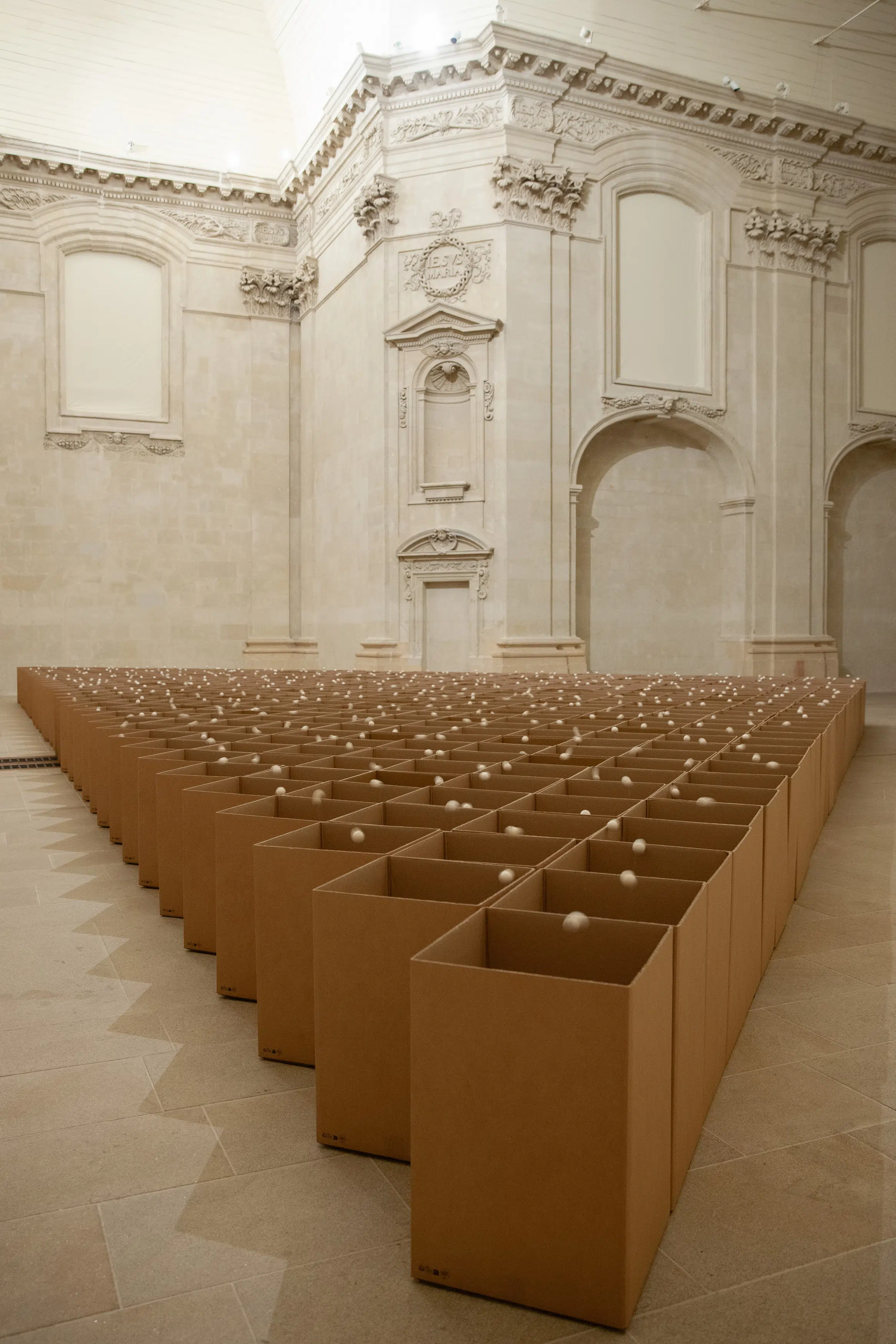
The installation consists of more than 500 individual elements made of cardboard and a simple mechanical system that generates sound through movement and the collision of materials. Although all elements are made from exactly the same materials, each one develops its own behavior based on the dynamic properties of the materials. This individuality can be observed both acoustically and visually. Despite the underlying simplicity of the mechanism, a high level of complexity and vitality emerges.
The installation contains many apparent opposites that coexist: order and chaos, individuality and mass, routine and chance, precision and imperfection, artificial and organic, simplicity and complexity. Visitors are invited to lose themselves in the installation, to observe it acoustically, spatially, and visually, and to make their own connections and associations to different subjects and references.
For me, the work relates to many and very diverse fields: nature, robotics, society, mathematics, physics, absurdity and irony, politics and power structures, sustainability, control, as well as psychological and neurological phenomena such as pareidolia - when our brain seems to perceive patterns that don't exist. This leads to questions about perception, reality, and even existence. In that sense I hope the work may encourage some of us to reflect on ourselves and the world around us.
Can you tell us more about this installation?
The installation is made up of over 500 cardboard elements and a simple mechanical system that produces sounds through the movement and collision of the materials. Although all these elements are made of the same materials, each develops its own behavior linked to the dynamics of the material. This individuality is perceptible both acoustically and visually. Despite the simplicity of the mechanism, great complexity and vitality unfold.
The installation brings together many coexisting opposites: order and chaos, individuality and mass, routine and chance, precision and imperfection, artificial and organic, simplicity and complexity. Visitors are invited to lose themselves in the installation, to observe it acoustically, spatially and visually, and to create their own links and associations with different subjects and references.
For me, the work is connected to many diverse fields: nature, robotics, society, mathematics, physics, absurdity and irony, politics and power structures, sustainability, control, as well as psychological and neurological phenomena such as pareidolia - when our brains perceive patterns that don't exist. This leads to questions about perception, reality and even existence. I hope the work will inspire some to reflect on ourselves and the world around us.
-
Video of the artist's work

-
Workshop with students from the Nantes School of Fine Arts

For a week, students from the Ecole des Beaux-arts de Nantes worked with Swiss artist Zimoun on his installation 528 prepared dc-motors, cotton balls, cardboard boxes 60x40x40 cm, 2025, Chapelle de l'Oratoire. Back in pictures.

Scientific curator: Marie-Anne du Boullay, in charge of the 19th-century collections at the Musée d'arts de Nantes, based on an idea by Jean-Rémi Touzet, curator at the Musée d'Orsay, assisted by Anouck Sberro, exhibition assistant.