
-
Who is Merson?
Luc-Olivier Merson (1846-1920) was a strange character, a wholehearted artist with a frank and direct character, a man of integrity who defended his ideas to the detriment of his career. He came from a notable, cultured family: his father Charles-Olivier, born in Nantes (1822-1902), was a well-known painter and art critic.
Training
Luc-Olivier began drawing at an early age, entering Isidore Pils' studio to win the Prix de Rome (1869). He was noticed at the Villa Médicis (1870-1874) by Paul Eudel, a collector from Nantes, who commissioned a curious painting from him, Le sacrifice des poupées (The Sacrifice of the Dolls), now in the Musée d'Arts.
His career
On his return to France, Merson embarked on a highly successful career as a decorator. At the same time, he produced disturbing and seductive paintings acquired by public institutions: Le Loup d'Agubbio (Palais des Beaux-Arts de Lille), Saint Isidore laboureur (Musée des Beaux-Arts de Rouen) and Saint François prêchant aux poissons (Musée d'arts de Nantes). He accumulated honors without seeking them: Légion d'honneur (1881), member of the Salon jury (1889), member of the Académie des Beaux-Arts (1892), studio head at the École des Beaux-Arts de Paris (1905)...
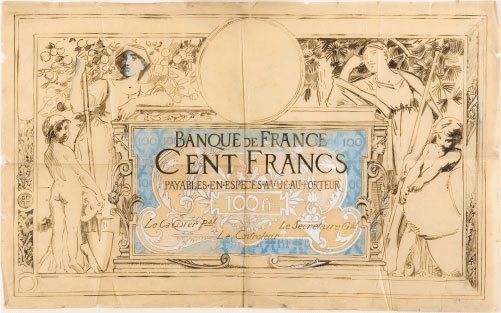
Tired of administration, he abandoned all his projects to his students in 1907 (the 500-franc bill, but also the Mexico City Parliament and the Sorbonne). In 1911, he resigned from his position at the École des Beaux-Arts de Paris in opposition to the Salon's new organization.
The man and the artist
Close to the Symbolists - the poet José-Maria de Hérédia and the musician Gabriel Pierné - he was nonetheless resistant to the idea of belonging to a style: "How strange it is, this illness we have of sticking labels on ourselves, which most of the time are there only to deceive the buyer," he told his friend Pierné.
Married to Elisabeth Contour, father of three children (Madeleine, Frédéric and François), Merson loved humor, disguised himself and painted landscapes and portraits for himself. He died in Paris in 1920.
A retrospective was then organized in Paris. His talent was only appreciated by specialists, until a masterly exhibition at the Musée des Beaux-Arts in Rennes brought him back into the limelight in 2008. Sought after by collectors, admired by connoisseurs, Merson's art is unclassifiable and his freedom fascinating.
Merson, a special character and a special world
A famous painter and decorator in his day, Luc-Olivier Merson (1846-1920) was a strange and brilliant character. Inspired by Antiquity and the Italian Primitives, he created a dreamlike, abundant and disturbing world, where bizarre elements unsettle the viewer's gaze.
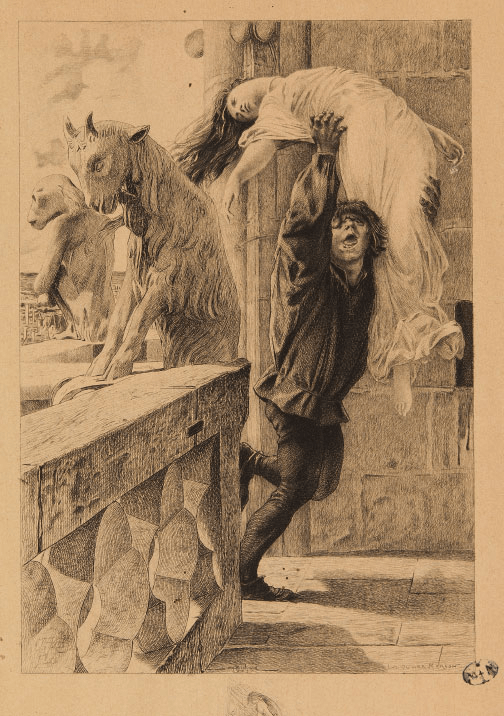
Illustrator of Victor Hugo's Notre Dame de Paris and José-Maria de Hérédia's Les Trophées, talented engraver and illusionist painter, Merson combined all techniques to create sets and ornamental motifs for the Sorbonne and the Opéra Comique.
Son of art critic Olivier Merson, who was also an illustrator and decorator, Luc-Olivier Merson was well-schooled. In 1869, after training in Pils' studio at the École des Beaux-Arts in Paris, he was awarded the Grand Prix de Rome for his work entitled Le Soldat de Marathon (The Soldier of Marathon). At the Villa Medici, he studied above all the primitives and Raphael, the great model for a whole generation of artists during this period of rediscovery of the Renaissance.
He began to receive commissions, notably from the Nantes circle, such as the collector Paul Eudel. His religious paintings were very popular. Among the most famous: Le Repos pendant la fuite en Egypte (1880 - Nice, Musée des Beaux-Arts) and Saint François prêche aux poissons (1886 - Nantes, Musée d'arts). The artist was awarded a first-class medal at the Salon des artistes français in 1875 and a gold medal at the 1889 Paris Universal Exhibition.
A strong character, he never hesitated to put his career on the line to defend his ideas: appointed professor at the École des Beaux-Arts in 1894, he resigned in 1911 to protest against what he saw as a relaxation of academic studies. Inimitable, admired for his independence and talent, Merson remains an unclassifiable artist.
Curator:
Cyrille Sciama, curator in charge of the 19th century at the Musée d'arts de Nantes
Captions and credits
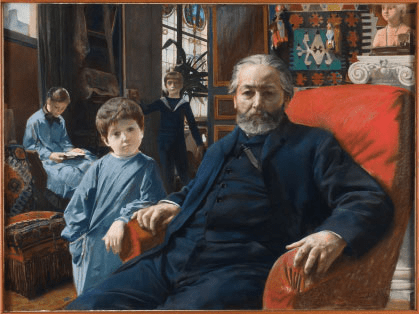
- Luc-Olivier MERSON, Portrait of the artist's father and his children (detail), s.d., pastel on paper. Musée d'arts de Nantes/C. Clos.
- Banque de France: cent francs © Pauline Betton
- Illustration for Victor Hugo's Notre-Dame de Paris © Pauline Betton