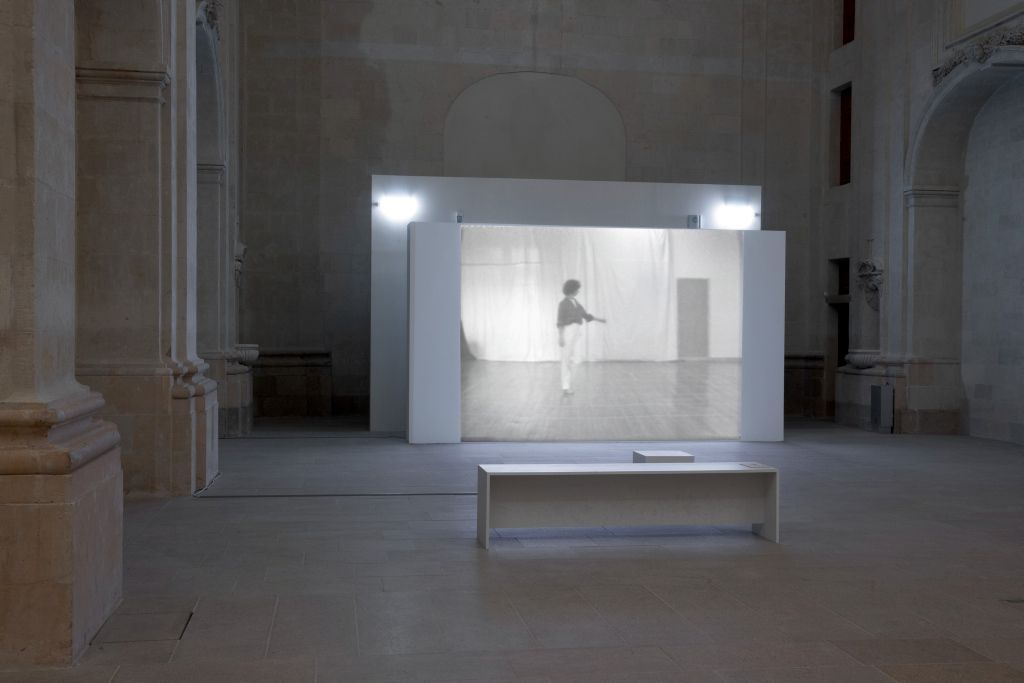
In the United States, the late 1960s and 1970s saw the emergence of a number of performance artists, including Vito Acconci, Simone Forti, Gordon Matta-Clark, Yvonne Rainer and Martha Rosler, of whom the Art Museum has an important video collection.
For me, dance has always been a way of exploring nature. I draw my material from the forms of nature. More than that, I identify with what I see, I put on its quality, its nature, or its spirit. It's an animistic process.
Simone Forti
Born in Florence, Italy, in 1935, Simone Forti began dancing at the age of 20, when her family emigrated to Los Angeles. She studied under the American choreographer Anna Halprin, among others, and during these years worked on exploring the body through improvisation. She learned to deconstruct academic dance and explore movement in its purest state. Joining the New York art scene in the early 1960s, she developed her first performances, focusing on the expression of liberated, raw movement.
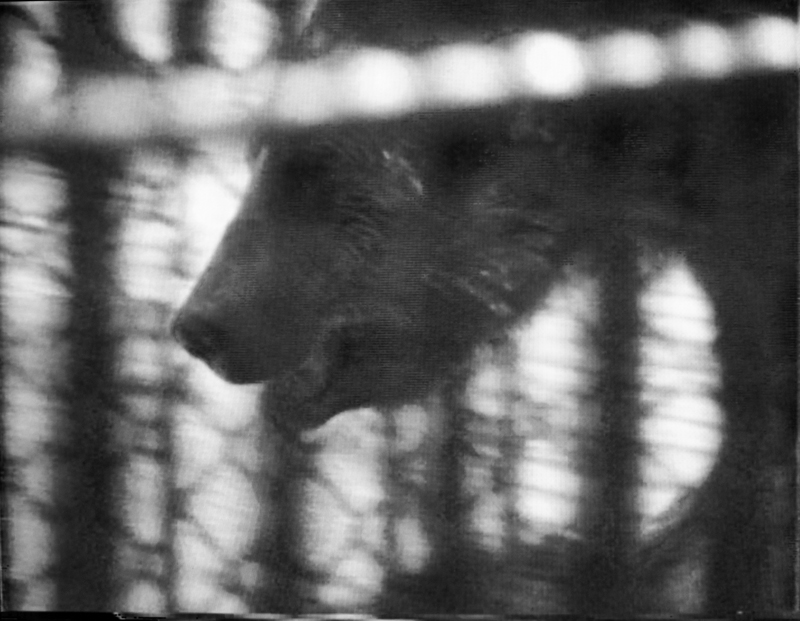
In 1974, for Three Grizzlies, Simone Forti studied the movements of animals at the Brooklyn Zoo. This video, which transcribes the repeated, anxious movements of caged grizzlies, is a study for Solo n°1, created the same year. The combination of Three Grizzlies and Solo n°1 reflects the artist's creative process: she seeks to determine the structures of animal motricity and then interprets them. Balance, momentum and their relationships become the principles of her work. In Solo n°1, an open metaphor for evolution and aging, the camera follows the dancer's movements ever more closely, creating an interaction between image and body expression.
General curator:
Sophie Lévy, curatorial director of the Musée d'arts de Nantes.
Scientific curator:
Katell Jaffrès, head of contemporary art collections at the Musée d'arts de Nantes.
Captions and credits:
Simone Forti, Three Grizzlies, 1974, video Black & white film, 17 minutes Digital Beta Pal, purchased 2005 © Courtesy of Video Data Bank.